

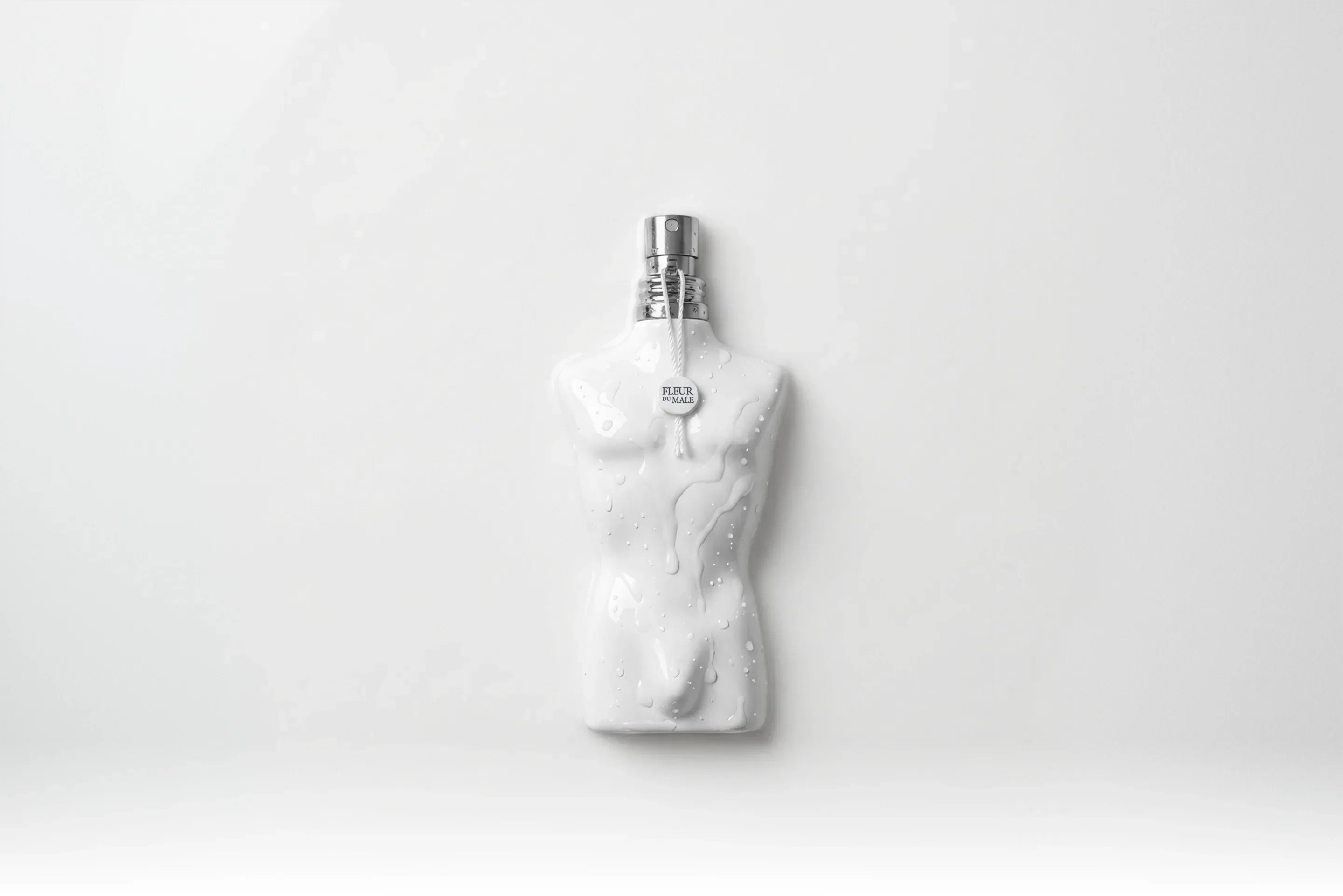
Jean Paul Gaultier is bringing Fleur du Mâle back for 2026, reviving one of the house's most distinctive—and most requested—discontinued fragrances. The white-torso original arrived in 2007 with a composition by Francis Kurkdjian that placed orange flower at the center of a men's aromatic fougère. Almost two decades later, the cult scent is returning in an edition that looks immediately familiar but comes with a more expansive note disclosure and one significant pre-launch question.
Is this the original formula in a new bottle, a necessary reformulation, or a reinterpretation? The honest answer is that Jean Paul Gaultier has confirmed a re-edition, but has not publicly said that the liquid is chemically identical to the 2007 release. That distinction matters for collectors. Here is what the brand has confirmed, what early reporting adds, and what remains to be verified once bottles reach skin.
The short version
Fleur du Mâle returns with its defining green petitgrain, radiant orange-blossom heart and coumarin-rich fougère base. The official pre-launch product module calls it an Eau de Parfum, while early news coverage calls it an Eau de Toilette. Until the public product page opens, treat the concentration—and any claim of an unchanged formula—with appropriate caution.

Fleur du Mâle 2026 at a glance
| Detail | What we know |
|---|---|
| House | Jean Paul Gaultier |
| Release | September 10, 2026, following limited pre-access |
| Fragrance family | Green floral aromatic fougère |
| Defining notes | Petitgrain, orange blossom and coumarin |
| Concentration | Official launch module: Eau de Parfum; early media report: Eau de Toilette |
| Reported size | 125 ml according to early coverage; final public product details should be checked at launch |
| Original perfumer | Francis Kurkdjian (2007 composition) |
Why the 2007 original became a cult fragrance
When Fleur du Mâle launched in 2007, the men's designer market was not short on fresh fragrances. Its difference was the kind of freshness it chose. Instead of centering marine notes, metallic citrus or a conventional lavender-and-wood structure, it made a lush white flower the protagonist. Petitgrain gave the opening a bitter green snap, neroli and orange flower created an almost creamy radiance, and aromatic herbs pulled the fragrance back toward fougère territory.
That tension was the identity: clean but not generic, floral but not delicate, nostalgic yet strangely futuristic in its stark white bottle. The name played with the phrase Les Fleurs du mal, while the perfume itself challenged the idea that an emphatic orange-blossom fragrance needed to be marketed as feminine. Francis Kurkdjian's composition felt both classical and confrontational.
Fleur du Mâle was eventually discontinued, but its absence only strengthened its reputation. Older bottles became sought-after, and requests for a return persisted across fragrance communities. Gaultier's new campaign directly acknowledges that community pressure: this comeback is being framed as a response to fans rather than an unrelated launch borrowing an archival name.

What Fleur du Mâle 2026 is expected to smell like
On paper, the 2026 scent opens green, brisk and slightly bitter. Petitgrain—the leafy, twiggy side of the bitter orange tree—is joined by bergamot and a green accord. That combination should give the first minutes a sharper aromatic edge than the soft white bottle suggests.
The heart is where the familiar personality emerges. Orange blossom sits beside cinnamon, geranium, juniper and a fougère accord. Orange flower can read clean and luminous, but also creamy, sweet, waxy and subtly indolic. Cinnamon should warm the center, while geranium and juniper add a drier aromatic frame. The effect sounds more structured than a simple soliflore.
The base broadens the classic coumarin foundation with tobacco, pine, vanillin and hay. Coumarin is responsible for the sweet, dry, hay-like warmth associated with tonka bean and traditional fougères. Tobacco and pine could deepen that contrast: plush sweetness against something dry, resinous and green. This is an interpretation of the disclosed materials, not a wear test; projection, longevity and the balance of those notes still need to be judged on skin.
The complete reported note pyramid
| Stage | Reported notes | Likely role |
|---|---|---|
| Top | Petitgrain, bergamot, green accord | Bitter citrus, leafy freshness and aromatic lift |
| Heart | Orange blossom, cinnamon, geranium, fougère accord, juniper | Radiant white floral warmth with spicy and herbal structure |
| Base | Coumarin, tobacco, pine, vanillin, hay | Sweet-dry fougère warmth with woody, grassy and smoky shading |
Jean Paul Gaultier's own campaign simplifies the story to three pillars—petitgrain, orange blossom and coumarin—while the longer pyramid above comes from the early Fragrantica coverage. Those two descriptions do not conflict; the brand is emphasizing the recognizable signature, while the press material exposes more of the supporting structure.
Petitgrain, orange blossom and coumarin: the three-part signature


These materials form a logical progression. Petitgrain starts with the plant's green exterior, orange blossom opens into the flower, and coumarin transforms the drydown into something softer and warmer. It is a complete olfactive arc contained within the bitter-orange theme, then extended by traditional fougère materials.
Is the 2026 edition the same formula as the original?
It is too early to say that it is identical. The campaign explicitly presents Fleur du Mâle as a re-edition and preserves its three most recognizable pillars. However, neither the official campaign page nor the teaser reviewed for this article states that the formula has been reproduced molecule for molecule. No new perfumer is identified in the public launch material, either.
That does not automatically mean the scent has been creatively changed. Fragrances returning after a long absence may need adjustments because of ingredient availability, regulatory limits, manufacturing standards or internal sourcing decisions. A longer published note list can also reflect more detailed marketing rather than an entirely new structure. Notes are descriptions, not formulas.
For that reason, the best language is precise: the 2026 Fleur du Mâle is an official return of the original concept and name, with the signature accord intact on paper. Whether vintage owners experience it as a faithful recreation, a polished update or a noticeably different perfume will require side-by-side wear once the final retail bottles are available.
Fleur du Mâle 2007 vs. Fleur du Mâle 2026
| Detail | 2007 original | 2026 return |
|---|---|---|
| Status | Original release, later discontinued | Official re-edition |
| Perfumer credit | Francis Kurkdjian | No new perfumer publicly announced at time of writing |
| Concentration | Eau de Toilette | Official pre-launch module says Eau de Parfum; early report says Eau de Toilette |
| Core profile | Petitgrain, neroli/orange flower, aromatic herbs and coumarin | Petitgrain, orange blossom and coumarin, supported by citrus, spice, aromatics, tobacco, pine, vanilla and hay |
| Bottle | Opaque white Gaultier torso | The white torso returns with refreshed campaign styling |
| Formula identity | Known vintage formula | Exact equivalence has not been confirmed publicly |
The older fragrance databases often reduce the original to petitgrain, neroli, chamomile and basil, with some listings also naming coumarin. The 2026 reporting is far more granular. The safest conclusion is not that every newly listed material is a newly added material, but that the returning edition is being described in greater detail.
The Eau de Parfum vs. Eau de Toilette discrepancy
This is the most important practical uncertainty in the pre-release information. The official Gaultier launch site's product data identifies Fleur du Mâle as Eau de Parfum. The Fragrantica news story announcing the return describes a 125 ml Eau de Toilette. Both cannot describe the same final retail label unless multiple versions are planned, and the campaign does not currently announce two concentrations.
For this guide, the brand's first-party label takes precedence, so Fleur du Mâle is treated as Eau de Parfum wherever one concentration must be shown. Still, a hidden or pre-launch product module can change before the public sale page opens. Readers should confirm the concentration printed on the box and bottle before ordering. If the final release is EDP, that alone would prevent it from being a literally identical presentation of the 2007 EDT, even if the scent profile remains close.
The white torso and presentation can return
Fleur du Mâle's bottle was never an incidental container. The opaque white torso removed the sailor stripes and colored glass associated with other members of Gaultier's fragrance family, making the floral concept feel almost sculptural. The 2026 campaign preserves that visual identity. Against blue-and-white sets, wet surfaces, leaves and flowers, the bottle looks like an archival object pulled back into the present.
The presentation can follows the same clean palette, with embossed water-droplet texture and vertical Fleur du Mâle lettering. Campaign imagery adds knotted cords and a dark flower, introducing a more tactile, slightly surreal edge without obscuring the familiar silhouette.

How it differs from Le Male
Despite the shared torso and family name, Fleur du Mâle should not be approached as a white-bottle flanker that simply sweetens the classic Jean Paul Gaultier Le Male. Le Male is famously built around lavender, mint, vanilla and an ambered fougère warmth. Fleur du Mâle shifts the spotlight toward bitter orange leaves and blossoms, with the flower supplying the fragrance's volume.
That makes the return especially relevant for wearers who find many current sweet designer masculines interchangeable. Its signature is not a dense caramelized amber or a blue shower-gel accord. It is a green white floral set against aromatic herbs and warm hay-like coumarin. Anyone curious about a newer floral direction from the house can also compare the idea with Le Beau Narcisse, although the two should not be expected to smell alike.
Who should try Fleur du Mâle 2026?
This return deserves a sample if you enjoy orange blossom, neroli, traditional fougères, green aromatics or floral fragrances that do not soften themselves into the background. It may also appeal to collectors who missed the original and want to understand why its departure left such a conspicuous gap in the Gaultier line.
- Vintage owners: sample side by side before deciding whether the re-edition can replace an older bottle.
- Orange-blossom fans: this is the most obvious audience; the flower is the identity, not decorative trim.
- Fougère lovers: the coumarin, geranium, hay and aromatic structure offer a bridge between a classical genre and a more expressive floral center.
- Modern designer-fragrance shoppers: try it if you want an alternative to heavily ambered, vanilla-dominant masculines.
- Blind buyers: proceed carefully. Orange flower can feel luminous and soapy to one wearer, dense and indolic to another.
The gender label is marketing, not a wearing rule. Fleur du Mâle was radical partly because it placed a voluptuous flower in a masculine-coded bottle and name. In 2026, that contrast feels less transgressive—but no less wearable across genders.
Release date, price and availability
Jean Paul Gaultier's teaser campaign points to September 10, 2026 as the main launch date after a limited pre-access allocation of 2,000 bottles. The official pre-launch product module lists a US price of $132. The same campaign build shows regional European pricing that varies by market, while the early Fragrantica report describes a 125 ml bottle at €126. Prices, sizes and retailer timing can change by country.
The public-facing product page had not fully opened when this guide was prepared on September 9, so final purchasing details should be checked directly with Jean Paul Gaultier after launch. The existing Fleur du Mâle page at Chaos currently documents the original fragrance profile and provides market-search options; it should not be interpreted as confirmation that the 2026 retail bottle is already in stock.
Final verdict: a comeback worth taking seriously
Fleur du Mâle is the kind of reissue that can add something genuinely different to today's designer shelf. Its return is not interesting only because discontinued bottles became expensive. The fragrance's core idea—green citrus leaves, a large orange-blossom heart and warm fougère materials—still occupies an unusual space. It is recognizable without following the dominant blueprint of the moment.
The expanded 2026 pyramid suggests more texture than the familiar four-note summary of the original: spice in the floral heart, then tobacco, pine, vanillin and hay around the coumarin base. Whether those facets feel newly prominent or merely make explicit what was always there is a question only comparative wearing can answer.
For now, the sensible verdict is enthusiastic but measured. Gaultier has restored the name, visual identity and central olfactive architecture that made Fleur du Mâle memorable. The final concentration, exact relationship to the vintage formula and real-world performance should be verified after launch. If the liquid lives up to the clarity of the concept, this will be more than nostalgia—it will be a welcome correction to the modern designer-fragrance landscape.
Editorial note
This is a pre-release first look based on Jean Paul Gaultier's official campaign and product-module data, supported by clearly identified fragrance-database reporting. Chaos Fragrances has not yet confirmed a wear test, final retail stock or formula equivalence with the 2007 edition. The article will remain a draft until reviewed.